

Weekly Newsletter August 17th to August 21st
RECAPPING LAST WEEK
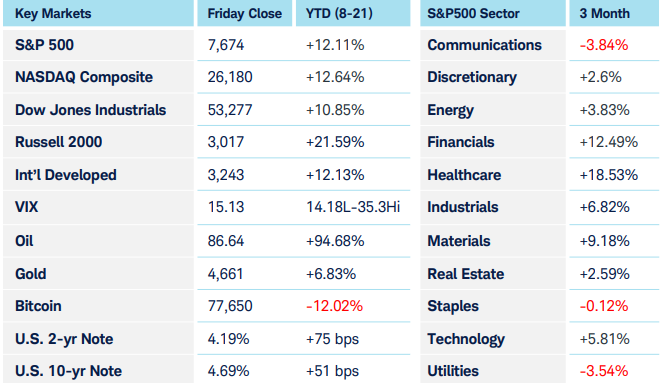
Global markets were dominated last week by a rise in long-term bond yields, renewed geopolitical risk surrounding Iran and a powerful rally in cryptocurrencies. Major U.S equity indices, some of which were at record highs the prior week, finished lower with the S&P 500 falling 1.4%, the Nasdaq 100 2.4%, and the Russell 2000 falling 1.6%. Except for a few of the big tech names, earnings season is largely in the rear-view mirror, so, the biggest pressure on equities came from the Treasury market. Treasury Secretary Bessent responded to the rise in long-term yields by announcing that his agency would at least double the size of their purchases of longer-dated Treasuries. This isn’t like the Fed’s previous policy of quantitative easing, which was intended to inject liquidity into the financial system. Rather, it’s intended to reduce the pressure on longerterm yields, which have also been impacted by massive corporate issuance from the hyperscalers. This also increases a reliance on shorter term Treasuries to help finance the budget deficit. So long as the curve remains “normal” rather than inverted, there could be an additional benefit in the form of lower interest expenses on newly-issued shorter term debt compared to the higher rates on the long-end of the curve. The reaction wasn’t just limited to Treasuries and equities. The dollar broke sharply and provided the catalyst for gold to add another leg up on its multi-week rally. But the biggest beneficiary was crypto, which decisively broke out of its months-long slumber. On the same day that Bessent made his announcement, President Trump hosted a crypto summit at the White House where he called upon the Senate to pass the CLARITY Act establishing rules within the crypto space, which is scheduled for a procedural vote on September 15th . Bitcoin rallied over 22% on the week and the whole crypto-adjacent ecosystem went along for the ride. Health Care was by far the biggest winner among S&P sectors, up over 4% behind promising cancer treatment news out of Moderna. Energy was up 2.8%, as crude oil firmed up after the expiration of the 60-day cease-fire and refining margins remain near record highs since the onset of the war. Technology, down over 3.5%, was the biggest loser. Finally, late breaking on Friday was news that the trade talks between the U.S. and Canada broke down, leading to 50% tariffs on some $20B worth of Canadian goods with a response from the Canadians for a “dollar for dollar” retaliation. Market reaction in early overnight trading however was muted, as commentators noted that the overall trading relationship stands at over $900B.
THE WEEK AHEAD
As we saw last week while market watchers try to predict which “known unknowns” will have the biggest impact on the markets—will it be earnings announcements, economic releases, or the outcomes of various negotiations? In reality, though, the most important factor of the week is often a surprise. With that in mind, let’s consider upcoming known events with unknown outcomes: Wednesday sees the release of the PCE report (which is, as every commentator will tell you, “The Fed’s Preferred Inflation Gauge.”) It’s expected to ease to a 3.7% annualized rate, remaining well above the Fed’s stated target of 2%. While Fed Chair Warsh has stated that he values a less data dependent and more markets-driven approach to policy making, he’ll expound on these views this week from the biggest platform yet: Friday’s keynote address at the Fed’s annual Jackson Hole symposium. For U.S. equities, the other major focus will be Nvidia’s earnings on Wednesday, given the company’s outsized influence at the center of the AI infrastructure and capex stories. Iran remains another “known unknown.” While the expiration of the 60-day ceasefire didn’t lead to an immediate resumption in hostilities, the two countries haven’t announced any new negotiations and the U.S. has pivoted towards ramping up economic pressure on the regime, with Treasury Secretary Bessent announcing plans for an “Economic D-Day.”
CHART OF THE WEEK
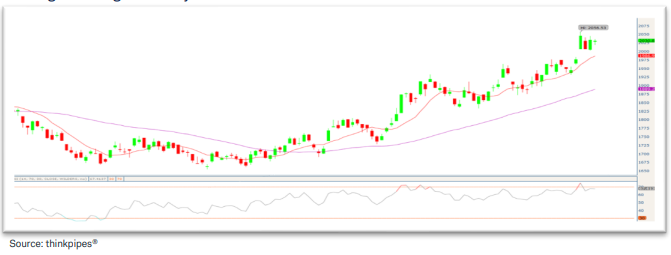
A Shot in the Arm for Health Care Stocks
The S&P Health Care sector spent much of the first half of 2026 consolidating and recovering from its spring lows, before moving throughout the summer and delivering a notable breakout on August 19th. That breakout came in the wake of positive results from a randomized trial testing a personalized cancer vaccine developed by Moderna and Merck. The mRNA-based vaccine is designed to prevent the spread of melanoma by training the immune system to identify and kill cancer cells. On Wednesday, August 19th Moderna shares soared to a recent high of $176.66 (+147%), and Merck shares rose to a new all-time high of $154.49 (+13%). While the breakout came from Wednesday’s big announcement, the set up started back on May 22nd when the 10-day SMA (red) crossed the 50-day SMA (purple) normally a strong indicator of an upcoming bullish trend. Since then, the sector’s performance has been strong, with both averages moving higher even before the major vaccine announcement. The vaccine news only bolstered confidence for investors in health care, taking the market to new highs. The recent breakout is also accompanied by RSI, which suggests strong momentum. With RSI currently at 68, momentum is robust but not yet excessively stretched; this could suggest that the sector has additional room to advance before reaching overbought territory.
Source: Charles Schwab Corporation
IMPORTANT LEGAL NOTICE AND DISCLOSURE INFORMATION
Investment advisory service is provided by SVL Holding Corporation dba SVL Investments Management (“SVL”), a California registered investment advisor. Advisory services are subject to advisory fees as disclosed on Form ADV.
Investing involves risks, and investment decisions should be based on your own goals, time horizon, and tolerance for risk. The forecasts or forward-looking statements are based on assumptions, may not materialize, and are subject to revision without notice. International investments carry additional risks, which include differences in financial reporting standards, currency exchange rates, political risks unique to a specific country, foreign taxes and regulations, and the potential for illiquid markets.
Past performance may not be indicative of future results. Therefore, no current or prospective client should assume that future performance of any specific investment, investment strategy (including the investments and/or investment strategies recommended or undertaken by SVL) or product made reference to directly or indirectly by SVL in its web site, or indirectly via a link to an unaffiliated third party web site, will be profitable or equal the corresponding indicated performance level(s). Different types of investments involve varying degrees of risk, and there can be no assurance that the future performance of any specific investment, investment strategy, or product (including the investments and/or investment strategies recommended or undertaken by SVL), or any non-investment related content, made reference to directly or indirectly on this site will either be suitable or profitable for a client or prospective client’s investment portfolio. Historical performance results for investment indices and/or categories generally do not reflect the deduction of transaction and/or custodial charges, the deduction of an investment management fee, or the impact of taxes, the incurrence of which would have the effect of decreasing historical performance results for investment indices.
Certain portions of SVL‘s web site (i.e. blog, Insights, newsletters, articles, commentaries, etc.) may contain a discussion of, and/or provide access to, SVL‘s (and those of other investment and non-investment professionals) positions and/or recommendations as of a specific prior date. Due to various factors, including changing market conditions, such discussion may no longer be reflective of current position(s) and/or recommendation(s). Moreover, no client or prospective client should assume that any such discussion serves as the receipt of, or a substitute for, personalized advice from SVL or from any other investment professional. SVL is neither an attorney nor accountant, and no portion of the web site content should be interpreted as legal, accounting or tax advice.
Rankings and/or recognition by unaffiliated rating services and/or publications should not be construed by a client or prospective client as a guarantee that he/she will experience a certain level of results if SVL is engaged, or continues to be engaged, to provide investment advisory services, nor should it be construed as a current or past endorsement of SVL by any of its clients. Rankings published by magazines, and others, generally base their selections exclusively on information prepared and/or submitted by the recognized adviser.
To the extent that any client or prospective client utilizes any economic calculator or similar device contained within or linked to SVL‘s web site, the client and/or prospective client acknowledges and understands that the information resulting from the use of any such calculator/device, is not, and should not be construed, in any manner whatsoever, as the receipt of, or a substitute for, personalized individual advice from SVL, or from any other investment professional.
Each client and prospective client agrees, as a condition precedent to his/her/its access to SVL‘s web site, to release and hold harmless SVL, its officers, directors, owners, employees and agents from any and all adverse consequences resulting from any of his/her/its actions and/or omissions which are independent of his/her/its receipt of personalized individual advice from SVL.