

Weekly Newsletter January 26th to January 30th
RECAPPING LAST WEEK
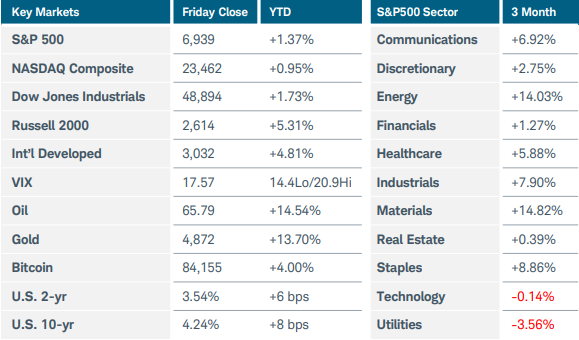
January came to a close with rising volatility as investors grappled with the latest Federal Reserve decision, the nomination of Jerome Powell’s successor, earnings reports from technology giants, and the possibility of another government shutdown. The S&P500 and Nasdaq Composite indices were little changed for the week, while the Russell 2000 fell 2%. The FOMC’s midweek decision to hold interest rates steady marked a turning point for both equities and precious metals. Chair Powell noted a clear improvement in the economic outlook and diminished risks to inflation and employment and gave little reason to expect further rate reductions soon. Equity indices peaked after rising leading up to the announcement. Thursday’s open was met with a sharp selloff in stocks and precious metals that was largely recovered by day’s end. On Friday, news of Kevin Warsh being nominated as the next Fed chair sent gold and silver prices tumbling by 9% and 28%, respectively, as traders dialed back expectations for policy easing. Warsh, who served as a Fed governor from 2006 to 2011, had a reputation as an inflation hawk, although he has recently argued for moderate rate cuts. While many remain concerned about the central bank’s independence, Warsh is seen as a pragmatist that is less dovish than some of his rivals for the role. His nomination may temper some risks of U.S. dollar debasement in the near term. The dollar rallied Friday, a respite from the intense selling pressure of the past two weeks. Turning to corporate earnings, the latest batch of reports from technology companies produced mixed results. Shares of Meta Platforms jumped on a strong forecast, while Microsoft plunged after reporting slowing cloud growth. Apple exceeded expectations on “staggering” demand for iPhones, but shares were up only modestly. Economic data was sparse with a few notable releases. U.S. Treasury yields edged higher after December’s Producer Price Index increased more than expected, a signal that inflation may accelerate in the months ahead. The U.S. trade deficit widened sharply in November, which could trim Q4 GDP growth estimates. Consumer confidence slumped this month to its lowest level since 2014 as anxiety over high prices and the jobs market persisted. On the international side, the Bank of Canada held rates steady for a second straight meeting while maintaining its forecast for modest growth and tame inflation. The Japanese yen came off its recent highs as speculation around currency intervention continued. U.S. Treasury Secretary Bessent denied that the U.S. would help support the yen but reports of the New York Fed conducting rate checks—a signal sometimes used to test reaction to a policy decision—has fueled recent spikes in the currency. Japan’s core inflation readings slowed in January mainly due to one-off factors but likely won’t derail the central bank’s efforts to raise rates. Last of all, Europe’s Q4 GDP grew by 0.3%, slightly above estimates of 0.2%. Germany’s inflation rate inched slightly higher to 2.1% YoY while unemployment reached a 12-year high.
THE WEEK AHEAD
Amid all the market-moving news that came out last week, investors once again confronted the risk of at least a partial government shutdown. Lawmakers strived to agree on a spending bill by last Friday’s midnight deadline while also negotiating limits on immigration enforcement. Meanwhile, another heavy dose of earnings announcements, U.S. jobs data, and several central bank decisions are on tap for this week. Mega caps Alphabet and Amazon are set to report, along with other key technology companies like Advanced Micro Devices, Palantir, NXP Semiconductor, and Qualcomm. Friday’s non-farm payrolls release is expected to show gains of around 70,000 jobs in January, and based on last week’s FOMC statement, solid economic growth seems to have eased some labor market concerns. The rest of the U.S. calendar includes February’s preliminary consumer sentiment reading and ISM manufacturing and services PMIs. Overseas, interest rate decisions arrive this week from central banks in the UK, Europe, and Australia. The BoE and the ECB are expected to keep rates level, while the Reserve Bank of Australia may consider a hike after Q4 inflation rose to 3.6% YoY. Money markets are pricing in around a 70% probability of such a move. Crude oil prices jumped more than 7% last week as tensions between the U.S. and Iran continued to rise, and OPEC was expected to keep its pause on output increases in place when it met over the weekend.
CHART OF THE WEEK
Broadening rotation
A great deal of attention has been focused on the U.S. dollar’s decline over the past year and the subsequent outperformance of non-American assets. Meanwhile, another important rotation has occurred within the U.S. equity markets. Since the beginning of November there has been a noticeable shift in leadership, as the mega-cap growth stocks that dominated for so long have yielded control. The chart below shows three-month returns for a variety of U.S. equity indices. Leading the pack are small- to mid-sized companies, represented by the Russell 2000 and S&P400 midcap indices, both up around 6% over this period. Next is the S&P500 Equal Weight index (+5.3%), which illustrates that large-cap stocks outside of the “Magnificent 7” are still performing well. Three other indices, the S&P500 value (+4%), S&P500 (+1.5%), and Nasdaq-100 equal weight (+0.5%), remain in positive territory. Bringing up the rear with slightly negative returns over the past three months are the Nasdaq-100 (market-cap weighted) and the S&P500 growth index. Although the chart represents a relatively short period of time, it may be surprising to see more stocks participating in a mature bull market that is entering its fourth year.
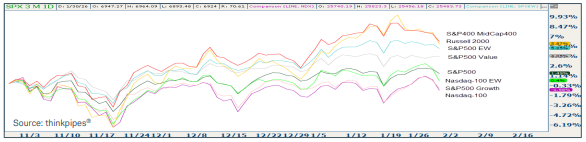
Source: Charles Schwab Corporation
IMPORTANT LEGAL NOTICE AND DISCLOSURE INFORMATION
Investment advisory service is provided by SVL Holding Corporation dba SVL Investments Management (“SVL”), a California registered investment advisor. Advisory services are subject to advisory fees as disclosed on Form ADV.
Investing involves risks, and investment decisions should be based on your own goals, time horizon, and tolerance for risk. The forecasts or forward-looking statements are based on assumptions, may not materialize, and are subject to revision without notice. International investments carry additional risks, which include differences in financial reporting standards, currency exchange rates, political risks unique to a specific country, foreign taxes and regulations, and the potential for illiquid markets.
Past performance may not be indicative of future results. Therefore, no current or prospective client should assume that future performance of any specific investment, investment strategy (including the investments and/or investment strategies recommended or undertaken by SVL) or product made reference to directly or indirectly by SVL in its web site, or indirectly via a link to an unaffiliated third party web site, will be profitable or equal the corresponding indicated performance level(s). Different types of investments involve varying degrees of risk, and there can be no assurance that the future performance of any specific investment, investment strategy, or product (including the investments and/or investment strategies recommended or undertaken by SVL), or any non-investment related content, made reference to directly or indirectly on this site will either be suitable or profitable for a client or prospective client’s investment portfolio. Historical performance results for investment indices and/or categories generally do not reflect the deduction of transaction and/or custodial charges, the deduction of an investment management fee, or the impact of taxes, the incurrence of which would have the effect of decreasing historical performance results for investment indices.
Certain portions of SVL‘s web site (i.e. blog, Insights, newsletters, articles, commentaries, etc.) may contain a discussion of, and/or provide access to, SVL‘s (and those of other investment and non-investment professionals) positions and/or recommendations as of a specific prior date. Due to various factors, including changing market conditions, such discussion may no longer be reflective of current position(s) and/or recommendation(s). Moreover, no client or prospective client should assume that any such discussion serves as the receipt of, or a substitute for, personalized advice from SVL or from any other investment professional. SVL is neither an attorney nor accountant, and no portion of the web site content should be interpreted as legal, accounting or tax advice.
Rankings and/or recognition by unaffiliated rating services and/or publications should not be construed by a client or prospective client as a guarantee that he/she will experience a certain level of results if SVL is engaged, or continues to be engaged, to provide investment advisory services, nor should it be construed as a current or past endorsement of SVL by any of its clients. Rankings published by magazines, and others, generally base their selections exclusively on information prepared and/or submitted by the recognized adviser.
To the extent that any client or prospective client utilizes any economic calculator or similar device contained within or linked to SVL‘s web site, the client and/or prospective client acknowledges and understands that the information resulting from the use of any such calculator/device, is not, and should not be construed, in any manner whatsoever, as the receipt of, or a substitute for, personalized individual advice from SVL, or from any other investment professional.
Each client and prospective client agrees, as a condition precedent to his/her/its access to SVL‘s web site, to release and hold harmless SVL, its officers, directors, owners, employees and agents from any and all adverse consequences resulting from any of his/her/its actions and/or omissions which are independent of his/her/its receipt of personalized individual advice from SVL.