

Weekly Newsletter July 27th to July 31st
RECAPPING LAST WEEK
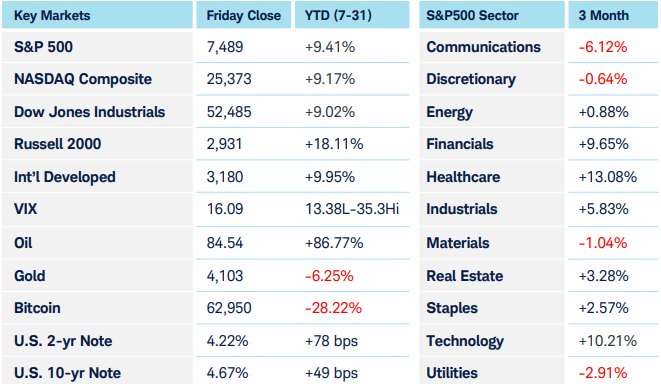
The dominant theme in global equity markets this past week was the intersection of earnings season, monetary policy and the ongoing repricing of the semiconductor sector. With more than one-third of the S&P 500 reporting quarterly results, for the most part corporate America continued delivering resilient earnings growth despite a backdrop of higher interest rates and persistent inflation. While most companies’ reported earnings exceeded consensus expectations, investors remained highly selective, rewarding firms that paired strong results with constructive forward guidance while showing little patience for earnings misses or signs of slowing demand. Nowhere was that dynamic more evident than within the semiconductor industry, where elevated expectations fueled another bout of extreme volatility. Chipmakers extended their steep decline early in the week—in addition to ongoing concerns about hyperscalers’ ability to sustain their capex spending, reports suggest that some Chinese firms are close to replicating highly specialized chip manufacturing techniques. These have, up to now, been the proprietary realm of firms like ASML. South Korea’s Kospi was particularly volatile, as heavyweight semiconductor manufacturers Samsung and SK Hynix led first a selloff and then the subsequent rebound. Those two stocks out of the index’s total of 833 constituent companies account for 50% of its overall weighting, and they led Friday’s 18% rally. Markets went into the Federal Reserve’s midweek meeting more uncertain of the outcome than at any point in the past 10 years. Afterward, markets digested the Federal Reserve’s decision to hold rates steady, as well as Chair Kevin Warsh’s post-meeting press conference. Warsh reiterated a firm commitment to reaching the stated goal of 2% annualized inflation and in the Q&A stressed that future Fed decisions would primarily be guided by market cues, devoid of the influence of Fed forecasts and dot plots. Perhaps the only group more upset than the cottage industry of “Fed watchers”, facing a future of less commentary and fewer projections for their content were investors on the long end of the curve, who saw rates rise to 18- year highs amid a sharp steeping of the yield curve. Warsh stated that market rates, which had moved uniformly higher across the yield curve since the last meeting, had the effect of tightening financial conditions. However, considering the post-meeting steepening, Fed Fund futures are now pricing in a 65% chance of a hike in the overnight rate at the September meeting. The move in long-term interest rates weighed on the rate-sensitive S&P Utilities and Real Estate Sectors, while the steeping curve supported Financials. Consumer Discretionary, up over 6%, was by far the top performing sector but as we mentioned last week, Amazon holds an approximately 22% weighting. Crude oil prices, although finishing lower on the week, continue to whipsaw in response to daily developments in the Iran conflict. The dollar was lower, at first reacting to the Fed’s holding pattern, but then on Thursday the Bank of Japan intervened, adding additional pressure by selling an estimated over $50 Billion USD/JPY to alleviate domestic inflationary pressures driven by the weak Yen. Precious metals and crypto remain on the sidelines.
THE WEEK AHEAD
Markets enter the first week of August focused on whether the recent resilience of the broader market, supported by overall strong corporate earnings, can continue in the face of growing uncertainty. Stubbornly elevated inflation and interest rates have not just risen across the curve but have steepened recently. Some of the earnings highlights include AMD, which should provide further insight into AI chip demand, Caterpillar for a broad read on global industrial and infrastructure-related demand, and Eli Lilly for the boom in GLP-1s as it relates to broader healthcare demand. The week’s most important economic release will be Friday’s U.S. employment report. As mentioned earlier, the new Fed chair professes that he will take cues from market signals, rather than remaining purely “data dependent”. So, reactions to the jobs report may concern themselves less with what it will cause the Fed to do, and more with what the figures mean for the future of the economy.
CHART OF THE WEEK
Carry on, Yen Wayward Son
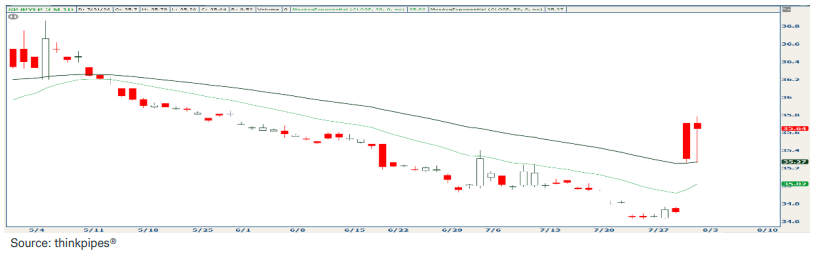
The Japanese Yen surged over 3% against the U.S. dollar from a 40-year low last week when their central bank stepped in to support the currency by buying an estimated 9 trillion yen, (about $59 billion). South Korea’s central bank coordinated this move with their own currency, and U.S. officials reportedly supported both. These gave the BOJ’s move more credibility than if Japan acted on its own, although the rally was cut short when the bank kept their policy rate at 1%. So long as the spread between U.S. and Japanese interest rates remains, so does the carry trade, and therefore downward pressure on the Yen. The carry trade, which involves borrowing Yen at low rates and flipping proceeds into higher-yielding investments, has been getting more attention lately. Eventually, those Yen must be repaid, but as long as rates stay low and the Yen is flat—or, better yet, depreciating—the strategy works. The problem arises when the Yen appreciates, meaning more dollars are needed to satisfy the loans. Investors tend to unwind their positions by buying Yen whenever those appreciation concerns arise. These purchases, of course, reinforce that cycle. We’re far from that point, but last week’s spike was a reminder not to not to take the carry trade for granted.
Source: Charles Schwab Corporation
IMPORTANT LEGAL NOTICE AND DISCLOSURE INFORMATION
Investment advisory service is provided by SVL Holding Corporation dba SVL Investments Management (“SVL”), a California registered investment advisor. Advisory services are subject to advisory fees as disclosed on Form ADV.
Investing involves risks, and investment decisions should be based on your own goals, time horizon, and tolerance for risk. The forecasts or forward-looking statements are based on assumptions, may not materialize, and are subject to revision without notice. International investments carry additional risks, which include differences in financial reporting standards, currency exchange rates, political risks unique to a specific country, foreign taxes and regulations, and the potential for illiquid markets.
Past performance may not be indicative of future results. Therefore, no current or prospective client should assume that future performance of any specific investment, investment strategy (including the investments and/or investment strategies recommended or undertaken by SVL) or product made reference to directly or indirectly by SVL in its web site, or indirectly via a link to an unaffiliated third party web site, will be profitable or equal the corresponding indicated performance level(s). Different types of investments involve varying degrees of risk, and there can be no assurance that the future performance of any specific investment, investment strategy, or product (including the investments and/or investment strategies recommended or undertaken by SVL), or any non-investment related content, made reference to directly or indirectly on this site will either be suitable or profitable for a client or prospective client’s investment portfolio. Historical performance results for investment indices and/or categories generally do not reflect the deduction of transaction and/or custodial charges, the deduction of an investment management fee, or the impact of taxes, the incurrence of which would have the effect of decreasing historical performance results for investment indices.
Certain portions of SVL‘s web site (i.e. blog, Insights, newsletters, articles, commentaries, etc.) may contain a discussion of, and/or provide access to, SVL‘s (and those of other investment and non-investment professionals) positions and/or recommendations as of a specific prior date. Due to various factors, including changing market conditions, such discussion may no longer be reflective of current position(s) and/or recommendation(s). Moreover, no client or prospective client should assume that any such discussion serves as the receipt of, or a substitute for, personalized advice from SVL or from any other investment professional. SVL is neither an attorney nor accountant, and no portion of the web site content should be interpreted as legal, accounting or tax advice.
Rankings and/or recognition by unaffiliated rating services and/or publications should not be construed by a client or prospective client as a guarantee that he/she will experience a certain level of results if SVL is engaged, or continues to be engaged, to provide investment advisory services, nor should it be construed as a current or past endorsement of SVL by any of its clients. Rankings published by magazines, and others, generally base their selections exclusively on information prepared and/or submitted by the recognized adviser.
To the extent that any client or prospective client utilizes any economic calculator or similar device contained within or linked to SVL‘s web site, the client and/or prospective client acknowledges and understands that the information resulting from the use of any such calculator/device, is not, and should not be construed, in any manner whatsoever, as the receipt of, or a substitute for, personalized individual advice from SVL, or from any other investment professional.
Each client and prospective client agrees, as a condition precedent to his/her/its access to SVL‘s web site, to release and hold harmless SVL, its officers, directors, owners, employees and agents from any and all adverse consequences resulting from any of his/her/its actions and/or omissions which are independent of his/her/its receipt of personalized individual advice from SVL.