

Weekly Newsletter October 26th to October 30th
RECAPPING LAST WEEK
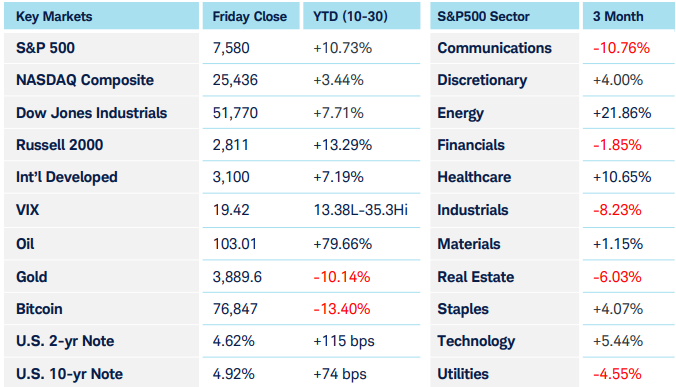
Technology and energy markets diverged sharply this week, while the Federal Reserve's steady hand proved less decisive than initially suggested. Equities opened on a constructive note Monday following news of Anthropic's S-1 filing, but sentiment reversed by midweek as hyperscaler earnings from Alphabet, Amazon, and Intel reignited concerns over the scale of AI-related capital expenditure. This, in turn, dragged the Nasdaq down as much as 2.8% on Friday. The selloff was broad enough to overwhelm a structural shift already underway in the market: correlation among the "Magnificent Seven" has fallen to its lowest point in a decade, indicating the decline of the single-basket trade that long defined the group. Apple was penalized in 2025 for lagging peers on AI spending and has more recently been rewarded for that same restraint—but even it was not spared in Friday’s selloff. This suggests the drawdown reflected a sector-wide repricing of AI-related growth and margin assumptions and not solely a verdict on companyspecific capex decisions. Friday’s $6.3 billion hack of Binance represented the largest such breach on record, adding a significant security event to the week’s cryptocurrency-market backdrop. The FBI linked the attack to an operation based in North Korea, while Binance said it would absorb the financial impact of the stolen coins rather than pass the losses on to its users. Energy told a different story: Chevron and Exxon reached all-time highs on strong refining profitability, as geopolitics drove WTI to join Brent above $100 per barrel Friday, as Ukraine has been responding to Russia’s attacks on their energy grid by striking Russian refining infrastructure. This, alongside the ongoing Iran conflict have added a persistent risk premium to crude, despite the U.S. administration’s efforts to ease domestic prices through direct negotiations with Russian producers. Wednesday's 10-2 FOMC decision to hold rates steady added further texture. Chair Warsh acknowledged elevated inflation but noted the Fed is awaiting an "accumulation of more information" before acting further. He also signaled his intent to reduce the frequency of ratedecision meetings, though he didn’t specify a timeline. The initial reaction pushed the 10-year Treasury yield above 5%, but that move reversed later in the week as tech-driven risk aversion spurred a flight to safe-haven instruments, pulling yields back below the threshold. This round trip indicated that equity stress, rather than any shift in the policy outlook, was the dominant driver. Most major central banks followed a similar path, holding rates steady despite persistent global inflation pressures. This points to a coordinated preference for patience over preemptive action. Collectively, the week underscored a market increasingly attuned to the sustainability of AI capex and to geopolitically driven energy-supply risk, with rate-sensitive assets taking their cues more from equity risk appetite than from policy signals themselves.
THE WEEK AHEAD
The U.S. congressional elections are likely to command the greatest attention over this consequential week. The elections will offer an important signal, indicating whether the current administration will face a shift in the political landscape that could prevent it from advancing its agenda over the next two years. The immediate market implications may depend not only on the election results themselves, but also on how investors interpret the potential path for policy and the extent to which the outcome changes expectations for the balance of power in Washington. Alongside the election, earnings from Apple, AMD, Palantir and Super Micro Computer should provide additional perspective on the durability and breadth of the technology and artificial-intelligence trade. These companies’ aggregate performance could help investors assess the degree to which AI enthusiasm is becoming more differentiated as various companies’ earnings diverge. By the end of the week, attention should shift toward the health of the U.S. consumer, with Friday’s unemployment-rate, hourly-earnings and consumer-credit readings helping to clarify how well households are navigating persistent inflation and broader economic pressures. If the labor market and wages remain strong, observers may conclude that consumers can still absorb these pressures, while weakness in employment or credit markets could indicate the opposite. The latter scenario could also imply that effects could extend beyond the consumer and impact growth expectations for business that are highly exposed to household spending. The week could therefore provide investors with a more complete picture of three important variables shaping the market outlook: the direction of U.S. policy, the underlying strength of the technology and AI trade, and the durability of the consumer.
CHART OF THE WEEK
NDX – Nasdaq 100: Feast or Famine?
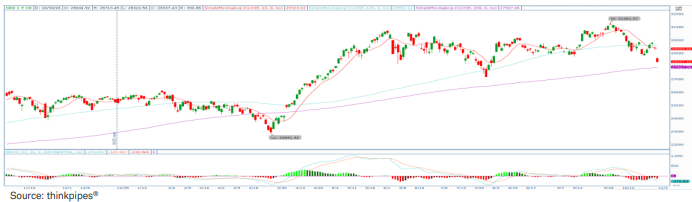
Technology stocks have come under renewed pressure as investors re-evaluate the cost and near-term return potential of the AI investment cycle. The last trading day of October was met with an accelerated decline: earnings reports from Amazon (AMZN), Intel (INTC), and Alphabet (GOOGL) indicated concerns about AI-related capital spending. Amazon signaled it will continue AI-related spending at elevated levels, while Intel warned of cash reduction amidst weaker PC demand and manufacturing challenges. The pressure has also spread across semiconductors with Nvidia (NVDA), Advanced Micro Devices (AMD), and Broadcom (AVGO) trading lower. From a technical perspective, the Nasdaq 100 (NDX) has pulled back considerably from its recent high of 31,361 on October 6th. The 9-day moving average crossed below the 50-day moving average on Monday, October 26th, which indicates a short-term bearish signal. This trend is confirmed by the large gap down from its opening price of 28,604 on Friday, compared to the previous close of 29,402. Currently the MACD is below zero and still moving lower, indicating downside momentum remains strong. From a long-term standpoint, the rising 200-day moving average of 27,297 could represent the next major support level for NDX. Are we currently experiencing a normal but notable short-term.
Source: Charles Schwab Corporation
IMPORTANT LEGAL NOTICE AND DISCLOSURE INFORMATION
Investment advisory service is provided by SVL Holding Corporation dba SVL Investments Management (“SVL”), a California registered investment advisor. Advisory services are subject to advisory fees as disclosed on Form ADV.
Investing involves risks, and investment decisions should be based on your own goals, time horizon, and tolerance for risk. The forecasts or forward-looking statements are based on assumptions, may not materialize, and are subject to revision without notice. International investments carry additional risks, which include differences in financial reporting standards, currency exchange rates, political risks unique to a specific country, foreign taxes and regulations, and the potential for illiquid markets.
Past performance may not be indicative of future results. Therefore, no current or prospective client should assume that future performance of any specific investment, investment strategy (including the investments and/or investment strategies recommended or undertaken by SVL) or product made reference to directly or indirectly by SVL in its web site, or indirectly via a link to an unaffiliated third party web site, will be profitable or equal the corresponding indicated performance level(s). Different types of investments involve varying degrees of risk, and there can be no assurance that the future performance of any specific investment, investment strategy, or product (including the investments and/or investment strategies recommended or undertaken by SVL), or any non-investment related content, made reference to directly or indirectly on this site will either be suitable or profitable for a client or prospective client’s investment portfolio. Historical performance results for investment indices and/or categories generally do not reflect the deduction of transaction and/or custodial charges, the deduction of an investment management fee, or the impact of taxes, the incurrence of which would have the effect of decreasing historical performance results for investment indices.
Certain portions of SVL‘s web site (i.e. blog, Insights, newsletters, articles, commentaries, etc.) may contain a discussion of, and/or provide access to, SVL‘s (and those of other investment and non-investment professionals) positions and/or recommendations as of a specific prior date. Due to various factors, including changing market conditions, such discussion may no longer be reflective of current position(s) and/or recommendation(s). Moreover, no client or prospective client should assume that any such discussion serves as the receipt of, or a substitute for, personalized advice from SVL or from any other investment professional. SVL is neither an attorney nor accountant, and no portion of the web site content should be interpreted as legal, accounting or tax advice.
Rankings and/or recognition by unaffiliated rating services and/or publications should not be construed by a client or prospective client as a guarantee that he/she will experience a certain level of results if SVL is engaged, or continues to be engaged, to provide investment advisory services, nor should it be construed as a current or past endorsement of SVL by any of its clients. Rankings published by magazines, and others, generally base their selections exclusively on information prepared and/or submitted by the recognized adviser.
To the extent that any client or prospective client utilizes any economic calculator or similar device contained within or linked to SVL‘s web site, the client and/or prospective client acknowledges and understands that the information resulting from the use of any such calculator/device, is not, and should not be construed, in any manner whatsoever, as the receipt of, or a substitute for, personalized individual advice from SVL, or from any other investment professional.
Each client and prospective client agrees, as a condition precedent to his/her/its access to SVL‘s web site, to release and hold harmless SVL, its officers, directors, owners, employees and agents from any and all adverse consequences resulting from any of his/her/its actions and/or omissions which are independent of his/her/its receipt of personalized individual advice from SVL.