

Weekly Newsletter October 5th to October 9th
RECAPPING LAST WEEK
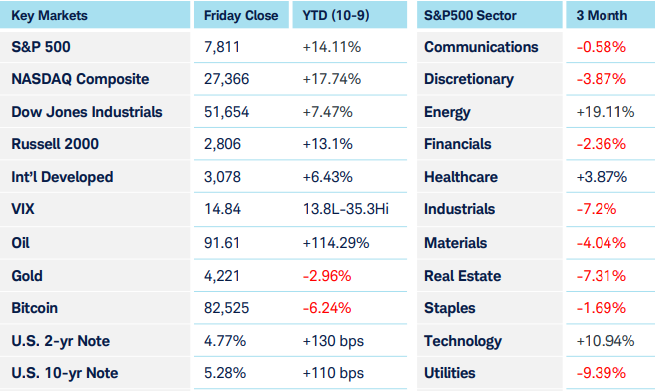
U.S. equity markets overall continued to rise, with both the S&P 500 and Nasdaq notching fresh all-time highs. The beleaguered Russell small cap index, however, continued to underperform. European markets were down modestly while Asian markets advanced. Treasury yields surged to fresh highs on Wednesday before cooling by the week’s end as rates and borrowing costs remained a major focus. On Friday, the Energy Information Administration reported that Hurricane Isaias, at that point rated a Category 3 storm, was impacting offshore crude oil and natural gas production in the U.S. Gulf Coast region. The U.S. Martine Minerals Administration estimated about 63% of the daily oil production and around 57% of natural gas production has been shut in, based on offshore operator reports from Thursday at mid-day. These events were projected to have a negligible (2 to three cent) impact on gasoline and diesel prices, but that is overshadowed by events happening in the Middle East and Russia impacting the oil market. Expensive energy, elevated yields, and geopolitical uncertainty have made markets more susceptible to negative surprises and have resulted in a more cautious stance by investors, reflected in broad equity fund outflows, weakening participation in the equity rally, and a shift toward bond and money-market funds. Bond fund inflows, meanwhile, were at record levels throughout the week. Risk appetite shows a more selective positioning, with inflows into technology, utilities, and industrials despite the broader equity fund outflow. OpenAI’s diminished annualized revenue projections reflected greater scrutiny of ballooning financing needs and costs relative to potential AI future returns. Bitcoin and gold were down most of the week, rebounding Friday. Federal Reserve minutes released Wednesday reinforced the higher-for-longer message regarding interest rates. Committee members see a resilient economy alongside stubborn inflation, and most expect additional tightening as needed. While the minutes didn’t telegraph an urgent series of rate hikes, they provided little reason to expect near-term policy relief. The future forecasted volatility of bonds has lurched higher over the past several weeks. The MOVE index uses an options-pricing model based on a weighted average of option probabilities to show collective expectations for future volatility in the fixed income market. It’s interpreted as a “VIX for bonds”, so it’s notable that its own divergence from the very low S&P 500 VIX levels is the largest it’s been since the turmoil last year surrounding Liberation Day. Additional economic reports such as the ISM Services PMI, while below forecast and last month’s reading are still showing expansion. Consumer confidence deteriorated, by 3.7% for the month, and the Current Economic Conditions Index tumbled by 12.2% month-on-month and is down 23.7% compared to October 2025.
THE WEEK AHEAD
Look for the market to focus on credit-market stability and earnings quality. Market participation and money flows will be influenced primarily by Wednesday’s September CPI release, as well as major bank earnings reports—all of this will impact interest rate concerns. U.S. stock markets are open for Monday’s Columbus Day holiday, but bond markets will be closed. Bank earnings kick off Tuesday with a slew of key quarterly reports from JPMorgan (JPM), Goldman Sachs (GS), Wells Fargo (WFC) and Citigroup (C). Analysts will be busy parsing credit quality, loan growth, trading revenues, deposit costs, and the all-important read-through on consumer health. The follow up PPI this Thursday will offer additional context for Wednesday’s CPI reading--should CPI ease, oil remain below recent highs, and Treasury yields retreat, we may see a more positive tone. More bullish participation of small caps would further cement a broad-based rally, as would continuing containment of high yield spreads alongside strength in crypto and a weakening U.S. dollar.
CHART OF THE WEEK
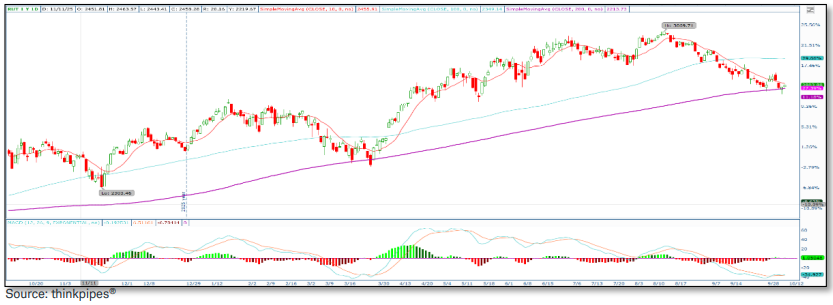
Small Caps, Big Tests
The Russell 2000 remains in a longer-term uptrend but has experienced meaningful pressure since its August peak, with higher interest rates and surging treasury yields being primary culprit. Higher borrowing and re-financing rates disproportionally impact smaller cap companies because they carry a higher proportional debt level compared to large cap companies. Rising rates can force smaller businesses to service debt at much steeper costs, squeezing profit margins. It can also lead to lower credit ratings, which means higher risk premiums when they borrow. Adding to the pressure, investors often pull their capital away from small caps when treasury yields spike due to risk concerns. That capital then funnels into large cap or mega cap companies for safety. As indicated in the RUT (Russell 2000 Index), small caps as an index have declined approximately 8- 9% since the all-time high of 3069.71. The 10-day simple moving average has crossed below the 100-day moving average, confirming the current pressure. However, hope is not lost yet. The closing quote of RUT on 10/08, landed nicely atop of the 200-day simple moving average. That average remaining below current prices could mean the broader bull trend is still intact despite recent weakening. Momentum indicators reinforce this stabilization theme. Represented by the MACD at the bottom of the chart, the MACD line remains below zero while displaying a bullish divergence and shows a steady improvement in the histogram crossing into a positive territory indicating fading downside momentum and the potential for a bullish momentum crossover.
Source: Charles Schwab Corporation
IMPORTANT LEGAL NOTICE AND DISCLOSURE INFORMATION
Investment advisory service is provided by SVL Holding Corporation dba SVL Investments Management (“SVL”), a California registered investment advisor. Advisory services are subject to advisory fees as disclosed on Form ADV.
Investing involves risks, and investment decisions should be based on your own goals, time horizon, and tolerance for risk. The forecasts or forward-looking statements are based on assumptions, may not materialize, and are subject to revision without notice. International investments carry additional risks, which include differences in financial reporting standards, currency exchange rates, political risks unique to a specific country, foreign taxes and regulations, and the potential for illiquid markets.
Past performance may not be indicative of future results. Therefore, no current or prospective client should assume that future performance of any specific investment, investment strategy (including the investments and/or investment strategies recommended or undertaken by SVL) or product made reference to directly or indirectly by SVL in its web site, or indirectly via a link to an unaffiliated third party web site, will be profitable or equal the corresponding indicated performance level(s). Different types of investments involve varying degrees of risk, and there can be no assurance that the future performance of any specific investment, investment strategy, or product (including the investments and/or investment strategies recommended or undertaken by SVL), or any non-investment related content, made reference to directly or indirectly on this site will either be suitable or profitable for a client or prospective client’s investment portfolio. Historical performance results for investment indices and/or categories generally do not reflect the deduction of transaction and/or custodial charges, the deduction of an investment management fee, or the impact of taxes, the incurrence of which would have the effect of decreasing historical performance results for investment indices.
Certain portions of SVL‘s web site (i.e. blog, Insights, newsletters, articles, commentaries, etc.) may contain a discussion of, and/or provide access to, SVL‘s (and those of other investment and non-investment professionals) positions and/or recommendations as of a specific prior date. Due to various factors, including changing market conditions, such discussion may no longer be reflective of current position(s) and/or recommendation(s). Moreover, no client or prospective client should assume that any such discussion serves as the receipt of, or a substitute for, personalized advice from SVL or from any other investment professional. SVL is neither an attorney nor accountant, and no portion of the web site content should be interpreted as legal, accounting or tax advice.
Rankings and/or recognition by unaffiliated rating services and/or publications should not be construed by a client or prospective client as a guarantee that he/she will experience a certain level of results if SVL is engaged, or continues to be engaged, to provide investment advisory services, nor should it be construed as a current or past endorsement of SVL by any of its clients. Rankings published by magazines, and others, generally base their selections exclusively on information prepared and/or submitted by the recognized adviser.
To the extent that any client or prospective client utilizes any economic calculator or similar device contained within or linked to SVL‘s web site, the client and/or prospective client acknowledges and understands that the information resulting from the use of any such calculator/device, is not, and should not be construed, in any manner whatsoever, as the receipt of, or a substitute for, personalized individual advice from SVL, or from any other investment professional.
Each client and prospective client agrees, as a condition precedent to his/her/its access to SVL‘s web site, to release and hold harmless SVL, its officers, directors, owners, employees and agents from any and all adverse consequences resulting from any of his/her/its actions and/or omissions which are independent of his/her/its receipt of personalized individual advice from SVL.