

Weekly Newsletter September 14th to September 18th
RECAPPING LAST WEEK
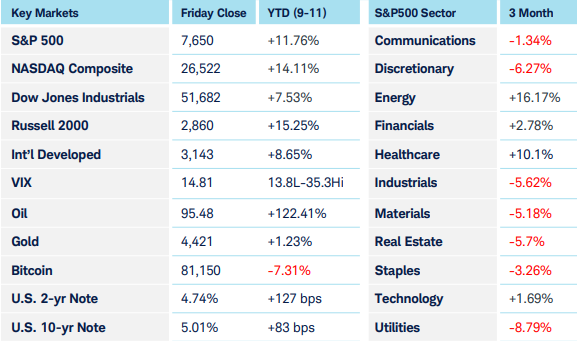
Global equity markets remained remarkably resilient last week despite another sharp rise in interest rates, elevated energy prices, and the first rate hike from the Federal Reserve in more than three years. U.S. equities initially came under pressure following Wednesdays widely anticipated 25 basis point increase in the Fed Funds target rate to 3.75%-4%, but the selloff was relatively short-lived, with most major indices recovering from their knee-jerk response to the rate announcement. The S&P 500 and Nasdaq remained close to their recent highs while the Dow and Russell underperformed. The biggest focus remained on the Fed meeting and the implications of the first rate hike since 2023. While the increase itself was widely expected (Fed Funds futures were priced at a 93% probability), the Fed’s indication that another hike could come before yearend pushed shorter-term Treasury yields higher, while longer-term yields were comparatively stable. The resulting flattening of the yield curve reflected the market’s view that monetary policy will remain restrictive even as longer-term inflation expectations appear more contained. Crude oil prices finally showed some signs of easing, with Brent and WTI both pulling back as Saudi Arabia indicated that additional production could return to the market. The decline in crude, however, has not translated into lower prices for refined products, with U.S. diesel prices reaching another alltime high well above $6 per gallon. The inelastic demand from the global trucking and shipping industry, the additional seasonal demand from farmers during the fall harvest and the onset of the heating season, combined with supply disruptions primarily related to the Russian Ukrainian war have all created the perfect storm for this lifeblood of the global economy. The U.S. Dollar also responded favorably to the Fed rate hike, including adding an additional leg up against the Yen after the Bank of Japan matched the Fed’s rate hike with its own widely anticipated 25 basis point hike on Friday. Crypto markets were also notably resilient despite the Senate’s failure to advance the CLARITY Act. The legislation sought to establish a comprehensive regulatory framework for digital assets by defining and delineating responsibilities between the SEC and CFTC. Shortly after the bill failed in the Senate, the SEC issued an “Innovation Exemption” for the next five years around Tokenized Securities Venues, which provided further support for the sector. In S&P Sectors, Healthcare was the best performer while the rate-sensitive Utilities and Financial sectors were the worst. Overall, the week continued to highlight the resilience of risk assets in the face of a more challenging macro environment driven by higher rates and energy costs.
THE WEEK AHEAD
Investors will have a relatively light economic calendar to digest next week, leaving markets focused on the signals that could influence expectations for another Fed Funds hike in October. Futures markets are currently pricing in a 57% probability of a 25-basis point increase. The Treasury market will provide an important real-time signal, particularly if short-term yields continue to rise relative to longer maturities. A further flattening of the yield curve would indicate that markets are increasing the probability of additional near-term tightening and growing increasingly optimistic that the Fed will be able to slay the inflation dragon. The two-year is already trading 88 basis points above the overnight effective Fed Funds rate, contrasted against the 2s-10s spread which has flattened to 27 basis points. Of course, oil prices, largely driven by the uncertainty surrounding the U.S.-Iranian conflict, remain problematic in dampening those inflation expectations. As outlined above, the tightness in the diesel market has the potential to be truly disruptive in the coming weeks. European politicians have jumped into the fray, threatening a “windfall profits” tax on refiners, but that rhetoric will do nothing to solve for the upcoming seasonal increase in demand combined with the reduction in refining capacity. Through it all, equities have continued to hold their own in these upwind conditions, seemingly awaiting the day that the macro environment provides a tailwind for the next leg of their journey
CHART OF THE WEEK
The Market Passes its Stress Test
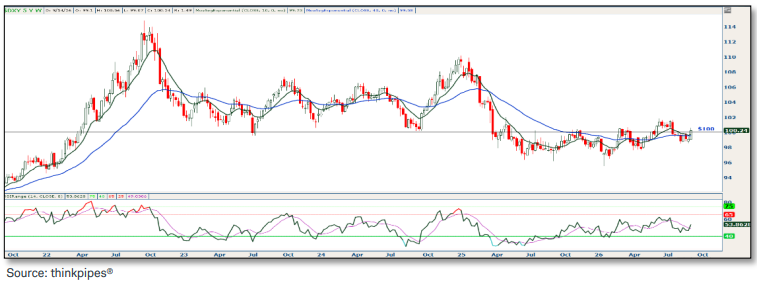
The U.S. Dollar strengthened last week, as shown by a 5-year chart of the Dollar index ($DXY) below. Spurred on by the Fed’s rate hike, the index broke back above $100 but was still within the range of the last 3 months between 98 and 102. The $100 price level has been an important inflection point for several years. It served as support from 2022–2024, broke below in 2025, and has acted as resistance most of the time since. Whether $DXY holds above $100 and continues trending higher has wide-ranging implications for nearly every other asset class as it would represent another form of monetary tightening. That can help soften U.S. inflation, but also drags on multinational corporations’ earnings, tightens financial conditions in emerging markets, and slows price appreciation in liquidity-sensitive assets like precious metals and crypto. Another important factor is the dollar/yen relationship, as further weakness in the yen could entice currency intervention from the BOJ, potentially affecting the yen carry trade. We got a glimpse of the volatility that it could cause in mid-2024. That’s currently not on the table, but important in the $DXY as well as the dollar/yen pair. Technical indicators are showing cautiously bullish momentum, but until $DXY breaks above the highs from June and July at $102, risk spilling into other markets remains low.
Source: Charles Schwab Corporation
IMPORTANT LEGAL NOTICE AND DISCLOSURE INFORMATION
Investment advisory service is provided by SVL Holding Corporation dba SVL Investments Management (“SVL”), a California registered investment advisor. Advisory services are subject to advisory fees as disclosed on Form ADV.
Investing involves risks, and investment decisions should be based on your own goals, time horizon, and tolerance for risk. The forecasts or forward-looking statements are based on assumptions, may not materialize, and are subject to revision without notice. International investments carry additional risks, which include differences in financial reporting standards, currency exchange rates, political risks unique to a specific country, foreign taxes and regulations, and the potential for illiquid markets.
Past performance may not be indicative of future results. Therefore, no current or prospective client should assume that future performance of any specific investment, investment strategy (including the investments and/or investment strategies recommended or undertaken by SVL) or product made reference to directly or indirectly by SVL in its web site, or indirectly via a link to an unaffiliated third party web site, will be profitable or equal the corresponding indicated performance level(s). Different types of investments involve varying degrees of risk, and there can be no assurance that the future performance of any specific investment, investment strategy, or product (including the investments and/or investment strategies recommended or undertaken by SVL), or any non-investment related content, made reference to directly or indirectly on this site will either be suitable or profitable for a client or prospective client’s investment portfolio. Historical performance results for investment indices and/or categories generally do not reflect the deduction of transaction and/or custodial charges, the deduction of an investment management fee, or the impact of taxes, the incurrence of which would have the effect of decreasing historical performance results for investment indices.
Certain portions of SVL‘s web site (i.e. blog, Insights, newsletters, articles, commentaries, etc.) may contain a discussion of, and/or provide access to, SVL‘s (and those of other investment and non-investment professionals) positions and/or recommendations as of a specific prior date. Due to various factors, including changing market conditions, such discussion may no longer be reflective of current position(s) and/or recommendation(s). Moreover, no client or prospective client should assume that any such discussion serves as the receipt of, or a substitute for, personalized advice from SVL or from any other investment professional. SVL is neither an attorney nor accountant, and no portion of the web site content should be interpreted as legal, accounting or tax advice.
Rankings and/or recognition by unaffiliated rating services and/or publications should not be construed by a client or prospective client as a guarantee that he/she will experience a certain level of results if SVL is engaged, or continues to be engaged, to provide investment advisory services, nor should it be construed as a current or past endorsement of SVL by any of its clients. Rankings published by magazines, and others, generally base their selections exclusively on information prepared and/or submitted by the recognized adviser.
To the extent that any client or prospective client utilizes any economic calculator or similar device contained within or linked to SVL‘s web site, the client and/or prospective client acknowledges and understands that the information resulting from the use of any such calculator/device, is not, and should not be construed, in any manner whatsoever, as the receipt of, or a substitute for, personalized individual advice from SVL, or from any other investment professional.
Each client and prospective client agrees, as a condition precedent to his/her/its access to SVL‘s web site, to release and hold harmless SVL, its officers, directors, owners, employees and agents from any and all adverse consequences resulting from any of his/her/its actions and/or omissions which are independent of his/her/its receipt of personalized individual advice from SVL.